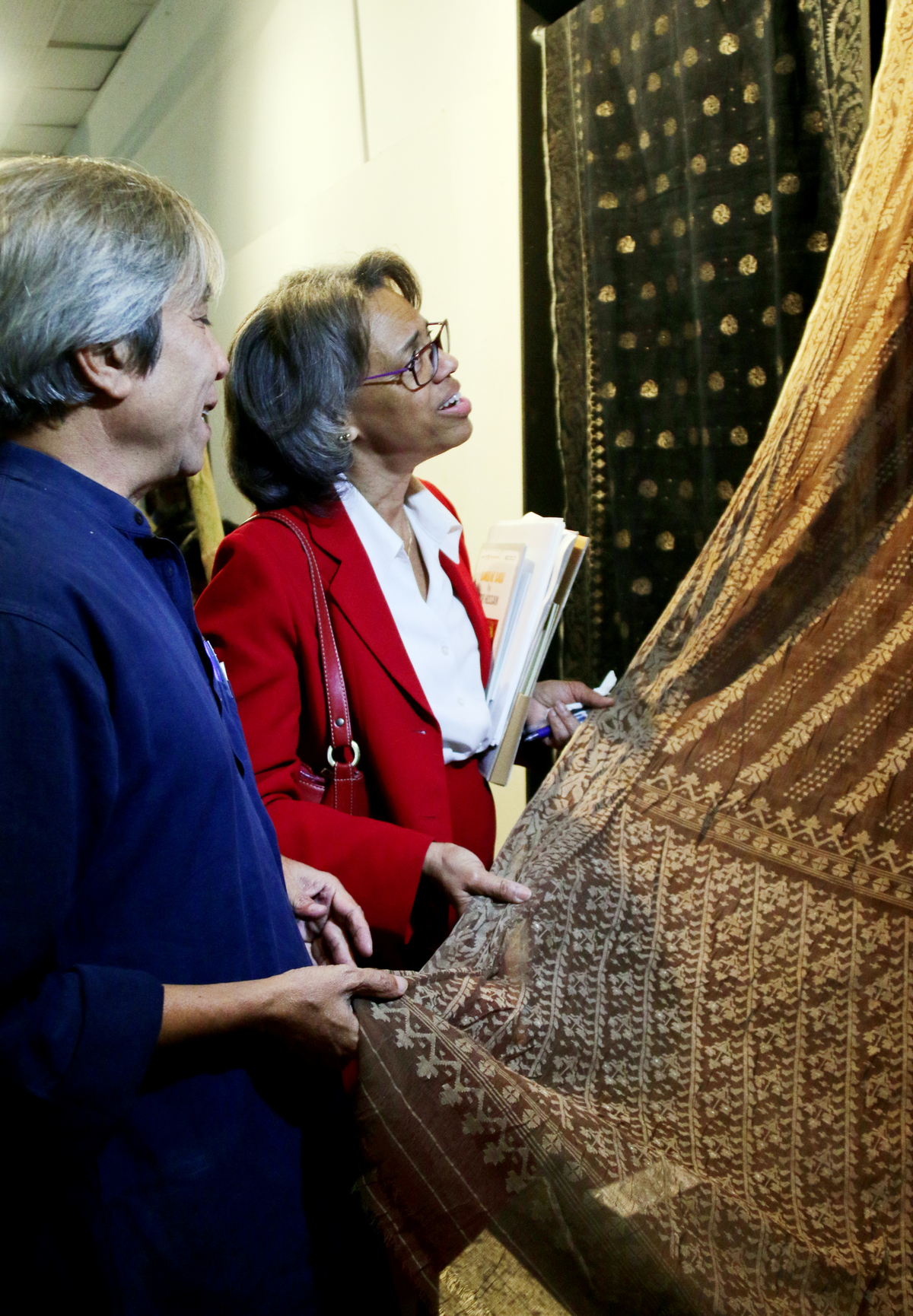


Bangladesh Jatiya Karushilpa Parishad – National Crafts Council of Bangladesh (NCCB) is organising a month-long Jamdani Festival, in collaboration with the Bengal Foundation from 6 September 2019 at Bengal Shilpalay, Dhanmondi, Dhaka.. It is also being partnered by four outstanding craft organisations of Bangladesh – Aarong, Aranya, Tangail Saree Kutir and Kumudini. For the first time ever images of antique Jamdanis, the famous “ the loom figured Muslin “ of Dhaka, have been sourced from international museums and private collectors to be replicated by masterweavers as well as the best of our young generation weavers. The Festival will highlight and celebrate this unique textile tradition of Bangladesh which has received UNESCO’s Citation as the Intangible Cultural Heritage of Humanity of Bangladesh in 2013 and the National GI Certification in 2014.
The Jamdani Festival will include:
NCCB hopes this initiative will restore the quality and exquisite design content of Jamdanis which set it apart from all other textiles of the world. We need everyone’s support to make it happen and hope you will join us in making this dream a reality.
Friday, 6 September 2019
Inauguration of the Festival and Mastercraftspersons Award Ceremony.
Bengal Shilpalay
House 42, Road 27, Shikh Kamal Sarani, Dhanmondi, Dhaka 1209
Saturday, 7 September 2019
Seminar discussing the past present and future of Jamdani
Women’s Voluntary Association (WWA)
House 20, Road 27, Dhanmondi, Dhaka 1209
This Festival is truly unique. The Jamdani exhibition has been organised with the sole objective of showcasing anew, one of the most precious and unique forms of art and craftsmanship from our heritage. It is imperative that we highlight and revive such treasures form our rich past, particularly in today’s modern world, and the Festival and exhibition is a testament to that. The artisans who weave these wonders and are masters in their craft, are a testament to the fact that passion, dedication, courage, patience and skill can achieve excellence even without literacy and formal education. The Festival and the exhibits showcased here is a culmination of the two years of research, exploration and technical practice in the craft of Jamdani weaving.
Jamdani is an organic art form, which, over the many years since its creation, has shifted in style and design, thanks to the many elements that have influenced the hearts and minds of the weavers of the Sitalakhya. The patterns and motifs lovingly and meticulously weaved into the fabric are representations of the patience and creative imagination of the craftsmen, who interpret their surroundings, thoughts and artistry through their unique work. Their art is an expression of the times and situation they live in. The craft, methods, innovation and technical aspects behind Jamdani have been featured throughout the exhibition.
The Festival can be interpreted as a means of paying homage to a part of our heritage, as well as to the artisans who have kept this craft alive over the years through their patience, dedication and resolve. Their work is a unique amalgamation of reality and imagination that has been skillfully crafted into the visual representation that is Jamdani.
The exhibits include rare and valuable Jamdani garments that have been painstakingly collected and brought together under one roof. These treasures not only provide glimpses into the richness of Bengali heritage, but also provide invaluable inspiration and proof that their creators are an integral part of our culture and tradition.
The combined, sincere efforts behind organising an event of this scale is to raise awareness about the fact that culture and heritage are undeniable parts of the human identity that provide so much depth and richness and it is this awareness that resonates throughout the Festival.
Inauguration
Friday 6 September 2019 at 5 PM
Venue
Bengal Shilpalay
House 42, Road 27, Sheikh Kamal Sarani, Dhanmondi, Dhaka 1209
The exhibition is open to all and can be viewed every day, except on Sundays, from 12 noon to 8 PM, until Saturday, 12 October 2019
Terms & Conditions
– Entry to exhibition halls are open to all.
– An initial security check will be conducted at the gate. You are requested to cooperate with security personnel.
– Anything larger than a small handbag/ purse will not be allowed inside the venue. Please drop off bags at the counter on the ground floor. You may carry your wallet, keys and mobile phones with you.
– No photography allowed. Professional cameras are not allowed to be brought into the exhibition halls.
– Members of the media may please check with Mr Rezwanul Kamal Chowdhury +880 1844050624 and/ or Mr Sheikh Saifur Rahman +880 1911 386903 for press material and coverage.
JAMDANI : PAST PRESENT & FUTURE
Date
Saturday, 7 September 2019
Venue
Women’s Voluntary Association (WVA)
House 20, Road 27, Dhanmondi, Dhaka.
10 AM Session 1 Moderator: Raja Datin Paduka Fuziah binti Raja Tun Uda
Member, World Crafts Council Asia Pacific Region (WCC-APR)
Q&A
12 PM Session 2 Moderator: Dr Firdous Azim
Rights activist and Chair, Department of English and Humanities, BRAC University
Q&A
2.30 PM Session 3 Moderator: Silmat Chisti
Managing Director, Bangladesh SME Corporation Limited & Member, NCCB
Panel discussion on financial constraints and sustainability challenges of Jamdani sector
participated by
Mominul Islam – Managing Director & CEO, IPDC Finance Ltd.
Md Safiqul Islam – Managing Director, SME Foundation
Rokia Afzal Rahman – leading entrepreneur and a former Adviser (Minister) to the Caretaker Government of Bangladesh.
The movement for the development of crafts in Bangladesh was led by Shilpacharya Zainul Abedin, Patua Quamrul Hassan, Tofail Ahmed, Mohammad Sayeedur and others. The effort gained momentum in 1974, with the organisation of the first national crafts exhibition. This was followed by the creation of Karika, the first crafts development and marketing organisation in the country.
Patua Quamrul Hassan, along with eleven others, established the National Crafts Council of Bangladesh (NCCB) in 1985. NCCB works regularly to promote and develop crafts and the artisans of Bangladesh, through various initiatives. The National Mastercraftspersons Award is one of the most prestigious awards initiated by NCCB, and is aimed at acknowledging and honouring the artisans and their time-honoured traditions. The award was, at its inception, given out every two years. Since 2010, NCCB partnered with the Bengal Foundation, and the Mastercraftspersons Award has been presented annually.
Jamdani weavers are often responsible for producing one of the most exquisite handloom weaves in the world. Men, women and children of the village are all involved at some stage of the production process, and most adult weavers often work as long as 18 hours a day with breaks for meals or prayers. 2019’s Mastercraftspersons Awards is a recognition of the hard work, skill and dedication shared by the Jamdani weavers of Bangladesh. The Award will be presented at the Jamdani Festival to four of the most gifted master weavers and apprentices for their skill and contribution to the community.
Date
Friday 6 September 2019 at 5 PM
Venue
Bengal Shilpalay
House 42, Road 27, Sheikh Kamal Sarani, Dhanmondi, Dhaka 1209
The Jamdani industry saw a steady decline during the mid-19th century, in the era of the British colonial period. The fall of the Mughal Empire deprived artisans of their most influential patrons, and the use of machinery in the English textile industry, as well as the subsequent import of lower quality, but cheaper yarn from Europe contributed to a steady decline.
In present times, the quality of Jamdanis continue to suffer due to the lack of fine cotton yarn, access to original designs and rising cost of production. Temporary displays and museum collections have continued to play a major role in documenting designs and acting as guides for traders and producers. Several non-government agencies have organised exhibitions in Dhaka, Delhi and London to promote handlooms and crafts. The first such exhibition, after the independence of Bangladesh, was organised in 1974 by a few enterprising individuals led by Shilpacharya Zainul Abedin. The purpose was to expose Bangladesh’s folk cultural heritage to consumers and designers. It led to the establishment of several craft organisations and boutiques in Dhaka and other cities. The Bangladesh Handloom Board and the BSCIC hold periodic textile exhibitions at which Jamdanis are displayed. Two exhibitions organised by Aarong in 1981 and 2010 demonstrated the wide variety of designs that were woven on very simple pit looms. In 1986 the White Chapel Art Gallery also arranged an exhibition of hand woven Jamdani and hand stitched kanthas. Since the Gallery was located in East London, it was an opportunity for residents (many of whom were migrants from Bangladesh) to see fabrics that had been made in Bangladesh.
In an attempt to restore the quality and exquisite design of the Jamdani, we have collected century-old designs from various historical records, museums and private collections from Bangladesh and abroad. The designs were used to conduct a series of workshops, where weavers reproduced these original designs. The reproductions from the weavers’ workshops will be showcased at the festival exhibition.
Supervisor Weaver
Master Weaver
Assistant Weaver
Jamdani Festival 2019 will feature screenings of four short documentaries. The films will be available online after its initial screening at the festival, along with photo albums of the workshop and exhibition.
Documentary Films
Design (3:43)
Jamdani designs are exceptional in their range and intricacy. This video explains how the designs are passed down from generation to generation. It also describes the fundamental designs that make up a Jamdani saree.
Pre-Weaving Process (4:49)
This video explores the pre- weaving processes required to produce a Jamdani saree. It starts with detailing how the yarn, warp and reed are prepared, mostly by women. We also learn about the many steps it takes to set up the loom before weaving can begin.
The Weaving Process (3:20)
This video looks at the labour-intense process of Jamdani weaving: Unlike other forms of handloom weaving, Jamdani has always been the work of two weavers – the ustaad or master and his apprentice. The two must work in unison to weave patterns perfectly.
A Weaver’s Life (6:22)
Mohammad Jamal Hossain has been weaving since he was 12 years old. He comes from a long line of Jamdani weavers. He now owns 25 looms. This film looks at Jamal’s life. It examines some of the hardships and difficulties he faces in producing Jamdani sarees.
Credits:
Producer/Director/Writer: Dina Hossain
Camera & Editor: Abdullah Al Naser
Sound: Masrur Masud
A TMMT Production
© Bengal Foundation 2019
A collectable book and folder will be available at the venue.
Jamdani is one of the finest Muslin textiles in Bengal, a proud heritage of the weavers of Sonargaon, Rupganj and Siddhirganj in the Narayanganj district. Unlike the techniques used for embroidery or prints, Jamdanis are woven directly on the loom using the weft technique. Its designs are unique and delicate, and are suggestive of floral motifs. It is a technique that has traditionally been handed down from generation to generation through oral instructions from master to apprentice.
The industry experienced a gradual decline since the mid-19th century, during the British colonial period. The fall of the Mughal Empire deprived artisans of their most influential patrons, and the use of machinery in the English textile industry, as well as the subsequent import of lower quality, but cheaper yarn from Europe, amongst numerous other factors, contributed to a steady decline.
The resurgence of Jamdanis began in the 1980s. It was primarily due to the effort of Bangladesh Small and Cottage Industries Corporation (BSCIC), a number of craft development organisations, NGOs and individuals, who supported artisans with access to credit facilities, raw materials and marketing.
Research and documentation from museums and private collections also made it possible for weavers to replicate original designs and layouts with great success. Several non-government agencies have organised exhibitions in Dhaka, Delhi and London to promote handlooms and crafts. The first such exhibition, after independence of Bangladesh, was organised in 1974 by a few enterprising individuals led by Shilpacharya Zainul Abedin. The purpose was to expose Bangladesh’s folk cultural heritage to consumers and designers. It led to the establishment of several craft organisations and boutiques in Dhaka and other cities. BSCIC holds periodic textile exhibitions where Jamdanis are displayed. Two exhibitions organised by Aarong in 1981 and 2010 demonstrated the wide variety of designs that were woven on very simple pit looms. Muslin Festival, in 2016, exhibited the original hand-spun Muslin Jamdani after a gap of several decades.
Fine Jamdani fabrics were also exhibited at a number of international exhibitions. In 1979 the Arts of Bengal exhibition showing the heritage of Bangladesh and Eastern India were displayed at the Whitechapel Art Gallery in East London. Later the National Crafts Council partnered with the Commonwealth Institute, London to celebrate the latter’s Silver Jubilee in 1987. The White Chapel Art Gallery organised an exhibition of hand woven Jamdanis and kanthas in 1988. Its catalogue entitled Woven Air illustrated a wide variety of designs. Since the Gallery was located in East London, it was an opportunity for residents – many of whom were migrants from Bangladesh – to see the fabrics which had been made in Bangladesh. Exhibitions, in recent times, have helped raise awareness about the rare skill and creativity of Bangladeshi weavers leading to a greater demand for fine Jamdani sarees around the globe.
In an attempt to restore the Jamdani to its original excellence, the National Crafts Council of Bangladesh and Bengal Foundation have jointly organised the Jamdani Festival, a celebration of the proud heritage of Jamdani weaving in Bangladesh.
Partnering with Aarong, Aranya, Kumudini and Tangail Saree Kutir – four of the biggest organisations in the country working with crafts, the Festival is exhibiting reproductions of century old Jamdani designs, as well as original antique garments, which have been collected from museums, historical records and private collections from Bangladesh and abroad.
The Jamdani Festival 2019 will feature a seminar discussing the past, present and future of Jamdani; screening of four short documentary films exploring the designs, process of weaving and the life of a weaver, and live demonstrations by weavers at the venue.
The Festival will also host the prestigious Master Craftspersons Award ceremony on the day of its inauguration. The award in 2019 will be presented to four of the most gifted Jamdani weavers and apprentices for their skills, creativity and contribution to the community.
This publication encapsulates the research undertaken by the National Crafts Council of Bangladesh over the past two years to trace traditional Jamdani designs . It explores the rich cultural heritage of Jamdani weaving, the skills shared by Bangladeshi weavers, and the significance of the geographical and ecological context of Narayanganj. We have carefully documented and featured number of our reproductions, as well as century-old antique garments, in great detail. We hope this book will inspire and aid in the future research on Jamdani weaving.
Credits
First published in Bangladesh in September 2019
Bengal Publications Limited
House 42, Road 16, Sheikh Kamal Sarani
Dhanmondi, Dhaka 1209, Bangladesh www.bengalpublications.com
© 2019 Bengal Publications Ltd.
All rights reserved. This book is sold subject to the condition that it shall not, by way of trade or otherwise, be lent, re-sold, hired out or otherwise circulated in any form of binding or cover other than that which it is published and without a similar condition including this condition being imposed on the subsequent purchaser.
Publisher
Abul Khair Editorial Panel
Ruby Ghuznavi, Hameeda Hossain, Chandra Shekhar Shaha, Luva Nahid Choudhury,
Estambul Hoque, Tanzim Ibn Wahab
Assistant Editor
Shah Nahian
Content Development Team
Farina Noireet, Maleeha Mazen Khan
Art Direction and Typography
Akram Ratan
Layout & Design
Emon Obaidullah, Syead Iqbal Hossain Graphics . Md. Shamim Islam
Photography
Abu Naser, Afzalur Rahman Xelon, Hadi Uddin, Kazi Anisul Haque Borun, Md. Rabiul Islam, Nurun Nahar Nargis, Rasel Chowdhury
Printing
Progressive Printers Pvt. Limited, Dhaka
Printed and bound in Bangladesh
The National Crafts Council of Bangladesh (NCCB), also known as Bangladesh Jatiya Karushilpa Parishad, founded in 1985, is the apex organization dedicated to the promotion, research, and preservation of traditional crafts in Bangladesh.
Any Bangladeshi citizen involved in the promotion, practice, development, preservation, or research of folk arts and crafts may be eligible for membership, subject to approval by the Governing Council.
NCCB offers Individual Membership, Organizational/Institutional Membership, Life Membership, and Associate Membership.
Applicants can apply for membership when invited by the Governing Council. Applications are reviewed by the Standing Executive Committee and approved by the Governing Council.
The membership fee is determined by NCCB and may vary depending on the category of membership.
Members gain opportunities for networking, participation in fairs and exhibitions, marketing support, international recognition platforms, and eligibility for NCCB awards.
Executive Committee members are selected or elected according to NCCB’s governing rules from among its approved members.


House 1, Road 5, Block A,
Satmasjid Housing Ltd, Mohammadpur,
Dhaka -1207, Bangladesh
craftscouncilbangladesh@gmail.com
Copyright © 2025. All rights reserved by NCCB. Designed and developed by Techka Studios
ন্যাশনাল ক্রাফ্টস কাউন্সিল অব বাংলাদেশ (NCCB), বা বাংলাদেশ জাতীয় কারুশিল্প পরিষদ, দেশের ঐতিহ্যবাহী কারুশিল্পের উন্নয়ন, গবেষণা ও সংরক্ষণে কাজ করা একটি শীর্ষস্থানীয় সংগঠন। এটি ১৯৮৫ সালে প্রতিষ্ঠিত হয়।
বাংলাদেশের যে কোনো নাগরিক, যারা লোকশিল্প ও হস্তশিল্পের উন্নয়ন, তৈরী, সংরক্ষণ, প্রচার বা গবেষণার সঙ্গে যুক্ত, তারা গভর্নিং কাউন্সিলের অনুমোদন সাপেক্ষে সদস্য হতে পারেন।
বাংলাদেশ জাতীয় কারুশিল্প পরিষদে চার রকমের সদস্যপদ রয়েছে-ব্যক্তিগত সদস্যপদ, প্রাতিষ্ঠানিক/সংগঠন সদস্যপদ, আজীবন সদস্যপদ এবং সহযোগী সদস্যপদ রয়েছে।
গভর্নিং কাউন্সিল সদস্যপদের জন্য আবেদন আহ্বান করে। আবেদন স্ট্যান্ডিং এক্সিকিউটিভ কমিটি যাচাই–বাছাই করে এবং গভর্নিং কাউন্সিলের অনুমোদনের মাধ্যমে সদস্যপদ প্রদান করা হয়।
সদস্যপদের বার্ষিক ফি সদস্যপদের ধরন অনুযায়ী নির্ধারিত হয়।
সদস্যরা পেশাগত নেটওয়ার্ক গড়ে তোলা, মেলা ও প্রদর্শনীতে অংশগ্রহণ, বিপণন ও প্রচারের সুযোগ এবং দেশি এন্ড আন্তর্জাতিক বিভিন্ন পুরস্কার ও স্বীকৃতির জন্য যোগ্যতা লাভ করেন।
নির্বাহী কমিটির সদস্যরা সাধারণত সংগঠনের অনুমোদিত সদস্যদের মধ্য থেকে NCCB–এর নিয়ম অনুযায়ী নির্বাচন বা মনোনয়নের মাধ্যমে নির্বাচিত হন।